
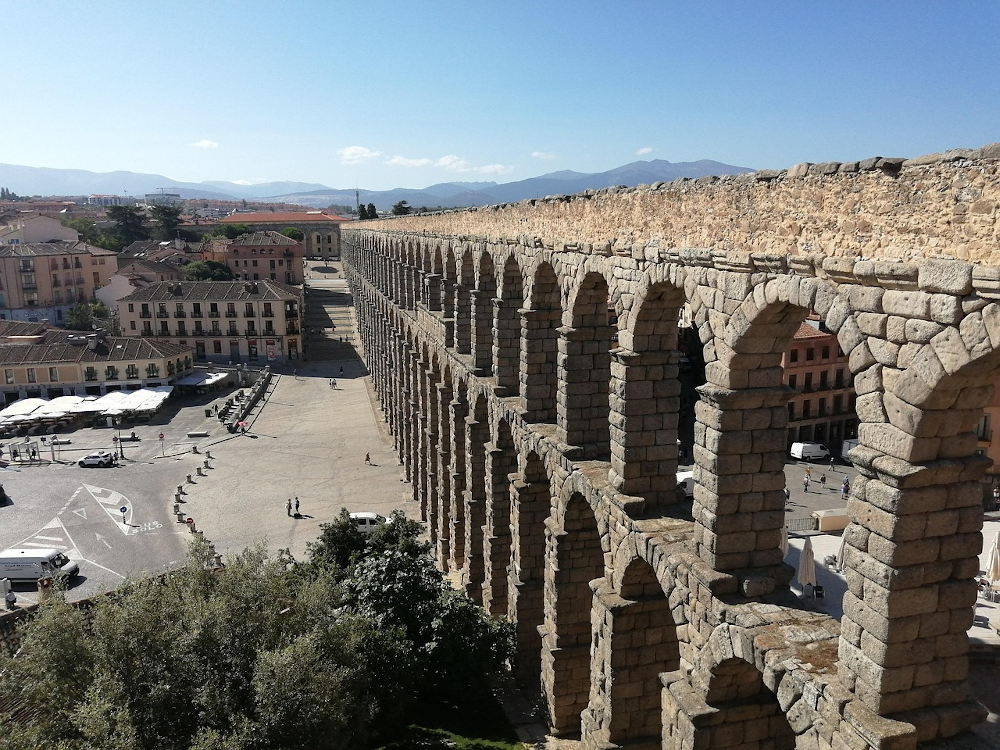
Standing proudly in the heart of Segovia, Spain, the Roman Aqueduct is one of the best-preserved and most awe-inspiring feats of ancient engineering. This monumental structure, built during the Roman Empire, has endured for centuries, capturing the imagination of historians, architects, and visitors alike. With its towering arches and precise stonework, the aqueduct is a testament to the ingenuity and craftsmanship of Roman civilization.
A Glimpse into History
The construction of the Roman Aqueduct of Segovia dates back to the late 1st century AD, during the reigns of Emperor Domitian or Emperor Trajan, and was later completed under Emperor Hadrian. The aqueduct was designed to transport water from the Frío River, located approximately 10 miles (16 kilometers) outside the city, to the heart of Segovia, ensuring a steady supply for its inhabitants.
What makes this aqueduct remarkable is its precise construction—built entirely from granite blocks without the use of mortar or cement. The Romans employed a technique known as dry stone construction, relying solely on the weight and balance of the stones to maintain stability.
Architectural Excellence
One of the most striking features of the aqueduct is its two-tiered system of arches, which stretch over 800 meters (2,624 feet) through the city. The most iconic portion, located in Plaza del Azoguejo, consists of 167 arches reaching a height of nearly 29 meters (95 feet) at its tallest point.
The structure is composed of over 20,000 granite blocks, carefully cut and assembled without the use of binding agents. The Roman architects relied on advanced mathematical calculations and precise techniques to distribute the weight evenly, ensuring the aqueduct’s durability over the centuries.
The Aqueduct’s Role in Segovia
Beyond its architectural beauty, the aqueduct served a crucial function in providing water to Segovia. The transported water was directed into various distribution points, supplying homes, public baths, and fountains throughout the city. Though no longer in use today, its presence remains a symbol of the city’s Roman heritage and its enduring legacy.
In 1985, the Roman Aqueduct of Segovia was declared a UNESCO World Heritage Site, preserving its status as an invaluable historical and cultural monument.
A Monument of Eternal Beauty
The Roman Aqueduct of Segovia is more than just an ancient structure—it is a testament to the brilliance of engineering, the passage of time, and the historical legacy of Spain. Whether admired from a distance or explored up close, the aqueduct leaves an unforgettable impression, reminding us of the ingenuity of past civilizations.
Segovia’s aqueduct is a rare treasure, a lasting tribute to the artistry and skill of Roman builders, and an essential stop for anyone seeking to immerse themselves in Spain’s rich and enduring history.